Objective of 13-Card Rummy
In Indian rummy, every player is dealt 13 cards from two 52-card decks (plus printed jokers). The objective is to arrange all 13 cards into valid melds:
- At least two sequences (runs of consecutive cards in one suit).
- Of those, at least one must be a pure sequence — no joker substitution.
- The remaining cards must form sequences or sets (triples/quads of the same rank across suits).
The first player to make a valid declaration wins; the other players' ungrouped card values are added as penalty points. Full scoring is below — see also our step-by-step tutorial.
Card Values & Points in Rummy
| Card | Value | Notes |
|---|---|---|
| Number cards | Face value (2–10) | A 7♥ counts as 7 points |
| Face cards (J, Q, K) | 10 points each | Same for Ace |
| Ace | 10 points | Unmelded, Ace = 10 points |
| Jokers (printed & wild) | 0 points when melded | Count full value if never melded |
Pure Sequence Rules (the non-negotiable)
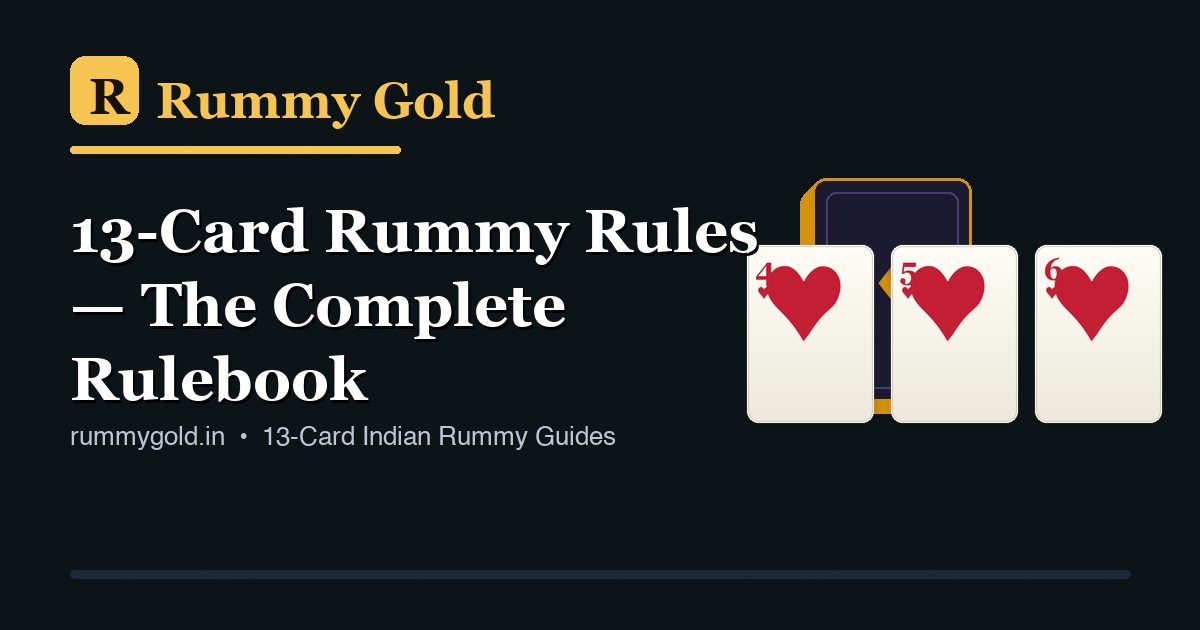
A pure sequence is 3 or more consecutive cards of the same suit, no joker used. Examples: 4♦5♦6♦ · 9♣10♣J♣Q♣ · J♠Q♠K♠A♠. Without a valid pure sequence, your entire declaration collapses and all card values count as penalty points — this is rule #1 to remember. Read joker behaviour in detail in our joker card guide.
Impure Sequence & Set Rules
- Impure sequence: consecutive same-suit cards with one card replaced by a joker or wild card — e.g. 2♥, Joker, 4♥ counts as 2♥3♥4♥.
- Set: 3–4 cards of equal rank in different suits — e.g. 8♣8♦8♥ or K♠K♦K♥K♣. A set may include one more card of the same suit only if it is a joker. You cannot duplicate two identical cards.
- An 8-card meld is allowed only as two sequences side by side (e.g. 4-5-6 & 8-9-10), never one 8-card run on a single declare basis.
Drawing & Discarding Rules
- On your turn, draw exactly one card — from the closed deck (stock) or open pile (discard).
- Discard exactly one card to the open pile to end your turn.
- When the closed deck runs out, its cards are reshuffled into a fresh stock while the open pile continues.
- Declare: discard your 14th (final) card into the finish slot, group the remaining 13 into valid melds and hit Declare.
Valid vs Invalid Declaration — Quick Examples
- 5♥6♥7♥ (pure) + 9♦10♦J♦Q♦ (pure 2nd) + 7♠7♣7♥ (set) + Joker filling the last meld
Two sequences including one pure, plus sets — correct.
- Only one sequence (no second sequence) — invalid.
- Two sequences but no pure one (joker used in both) — invalid.
- A 4-card Suited meld repeated from the same suit rank (8♥8♥8♥) — invalid.
Whole hand's cards count as penalty points.
Joker Rules at a Glance
- Printed jokers and one wild joker (a random card rank chosen each game) both act as substitutes in any meld.
- You cannot have a meld made only of jokers.
- Wild jokers can still be used naturally — e.g. if 7♦ is the wild card, the real 7♦ also counts as a regular 7♦ in a meld.
Master these rules with our visual how-to-play guide, then sharpen them with winning strategy tips. Questions? Check the full FAQ.
Related Cluster Guides
Rules Clear? Time to Practise.
Follow our download guide and join free-practice tables to apply every rule above without any risk.
Open the Download Guide →